Shoebill Tracking is one of the top experiences in Uganda. The Country ranked among the top destinations in Africa with high population of the remaining Shoebill storks in the World. This magnificent rare bird can be sighted at Mabamba Swamp, Murchison Falls National Park, Ziwa Rhino Sanctuary, Toro- Semuliki Wildlife Reserve and Lake Mburo National Park among others.
Shoebill tracking at Mabamba Swamp. Mabamba Swamp derives her name from the Lung Fish called “Mamba” in the local Language. Due to high numbers of Lungfish that used to be caught within the wetland, people termed it the area of Lung fish “Mabamba.”
Size of the swamp. Previously, the swamp covered an area of 2424 Hectares but was extended to Makanaga Bay and the surrounding wetlands hence covering 10,424 Hectares.
Vegetation Cover. The vast Marshes on the stretch of Lake Victoria drainage system consisting of colorful water plants like waterlilies, papyrus, spear grass and more, offer an ever-green scenic landscape along the shores and towards the tail end of the lake.
Bird Species. A variety of colorful bird species both migratory and residents, averagely 500 including the sought after Shoebill Stork are inhabitants of the Swamp.
How to get to Mabamba Swamp
It is a 30 minutes cruse by a local speed boat from Entebbe landing Site of Nakiwogo to Mabamba Swamp. Alternatively, you could cross by ferry to the mainland and drive for 30 minutes through villages to get to Mabamba landing site.
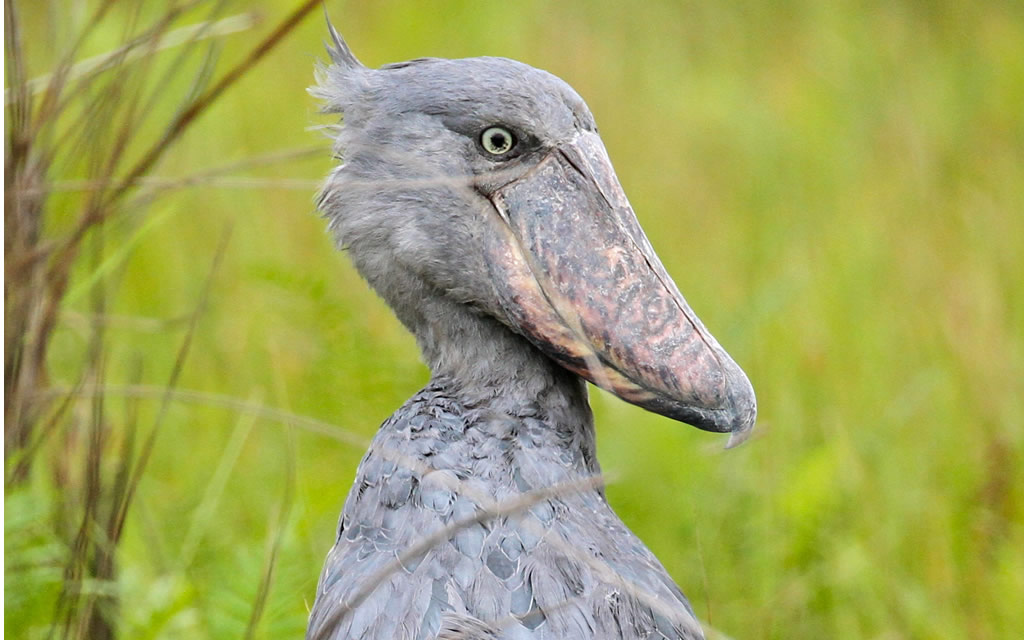
Shoebill Stork. A shoebill Stork derives its name from a bill that resembles a shoe. It is one bird believed to have never under gone evolution. A Dinosaur-like bird of relatively larger size with average height of 2-3 feet and wing span of up to 5 feet. It is estimated that there are only 3000 birds left in the World hence ranked Vulnerable on the list of International Union for Conservation of Nature.
The shoebill tracking experience at Mabamba Swamp. It involves use of local speed boats run by local site guides that always monitor the location, behavior pattern and safety of the Shoebills. Narrow water ways or paths are created within the wetland while viewing a variety of other colorful bird species, like Goliath Herons, African Jacanas, Egrets, Kingfishers, Warblers, Eagles and Weaverbirds among others, are inevitable to watch! Shoebills being solitary birds and rare to encounter, Mabamba Swamp offers over 80% chance of viewing this sought after bird. The activity in general may take 5-7 hours to and from the swamp while residing within Kampala and Entebbe areas.
Birding at Mabamba Swamp
With averagely 500 bird species both migratory and residents, Mabamba Swamp is a Bird Haven that core birders must not miss! A part from the sought after Shoebill Stork, other rare bird species are the Lesser Jacana, Papyrus Gonolek, Papyrus yellow Warbler, Africa Pygmy Goose, Rufus headed heron and blue swallows among others. The bird diversity and the short time at which they are watched, at a close proximity ranks Mabamba Swamp as one of the Birders hot spots. While on a local canoe, the silence along the created water trails offers higher chances of listening to bird calls and watching them. Apart from the rare species, a variety of colorful water birds like Egrets, Cormorants, Herons, Jacanas, Ducks, Eagles, Kingfishers, Kestrels, Harriers and many others can be sighted.
Birding on land in Mabamba
The boundary between the swamp and land offers a variety of other terrestrial and arboreal bird species. Through agricultural fields, surrounding trees and wild flowers, birds like Sunbirds, Turacos, Plantain Eaters, Sparrows, weavers and fly catchers among others can be seen. For a core birder, a full day trip is highly recommended.
Where to stay during your visit at Mabamba Swamp
There is quite a number of accommodation facilities to choose from depending on your tour plan. You could decide to Pass a night in Entebbe and transfer to Mabamba swamp in the morning by boat or road and return later in the afternoon. If you are to connect to another destination after your activities, either carry packed lunch or order hot lunch at any of the lodges within Mabamba like Nkima and Mabamba Safari Lodges.
When is the right time to visit Mabamba Swamp
Uganda’s climate is made up of two seasons; dry and wet. The Wet season runs from Mid-March to May and October to December while the dry season resumes from January February then June until September. The dry season therefore is the right time to visit Mabamba Swamp as birds are in abundance; water levels low and accessible by road without inconveniences. Chances of Shoebill sightings are as well higher compared to the wet season.
Recommended time for shoebill tracking. The activity has no fixed time to start but highly recommended in the morning. If you are residing in Entebbe Peninsular, endeavor to setoff by 7:00 AM so that in an hour you have arrived. In the Morning, birds are active than any other time of the day.
What to prepare for shoebill tracking and Birding in Mabamba Swamp
Some times the weather can be unpredictable, you are therefore advised to always carry rain gear regardless of the prevailing climatic conditions. In Uganda it may shine in the morning and after an hour, it rains. The reverse is also true.
Apply insect repellent before boarding the local speed boat. You are likely to encounter bugs during the activity.
With you, carry binoculars, a hat, bird book, sun screen, enough drinking water and snacks. This is because you spend much of the time on water than on land during activities.
Always keep the life Jacket on and follow instructions of your guide.
8 Days of Gorillas and Big 5 Safari in Uganda
10 Days of Gorillas and the Big 5 Safari in Uganda
16 Days of Gorillas and Wildlife Safari in Uganda and Rwanda
18 Days of Mount Rwenzori Hike and Classic Safari in Uganda
23 Days of Gorillas, Chimpanzees and Wildlife Safari in Uganda